On this page
For updates and practical guidance, continue to check this page. If conditions change, additional advice will be provided.
Current fuel status
Fuel supply in Victoria remains stable and there is enough fuel to meet normal demand.
Temporary disruptions may occur in some areas due to increased demand or supply chain pressure. Government and industry are actively monitoring the situation.
Australia is at Level 2 of the National Fuel Security Plan
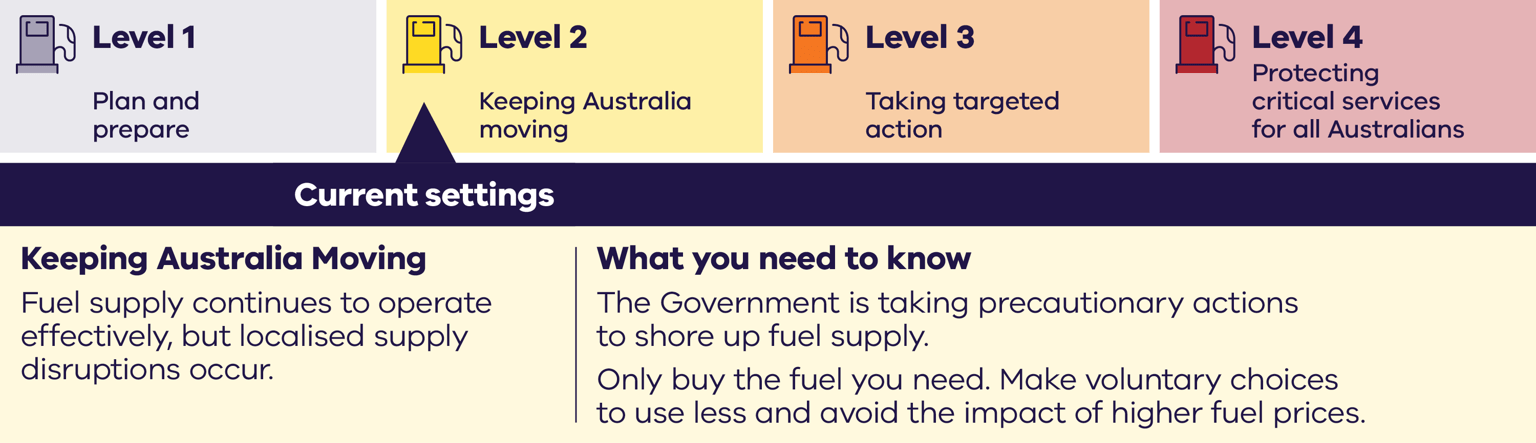
Level 1: Plan and prepare
Level 2: Keeping Australia moving
Level 3: Taking targeted action
Level 4: Protecting critical services for all Australians
Current settings
Keeping Australia Moving
Fuel supply continues to operate effectively, but localised supply disruptions occur.
What you need to know
The government is taking precautionary actions to shore up fuel supply.
Only buy the fuel you need. Make voluntary choices to use less and avoid the impact of higher fuel prices.
- Download image

Read more about the National Fuel Security Plan.
How Victorians can help
1. Plan ahead
- Buy only what you usually need, so no one has to go without.
- Fill up before you head out, especially if you rely on fuel for work, school or travel.
2. Check prices before you go
- Use Servo Saver in the Service Victoria app to check fuel prices near you.
- You can see where fuel is cheapest and plan when to fill up.
3. Be kind at the servo
- Service station staff are doing their best during a busy and stressful time.
- Please treat service station workers with patience and respect, just as you would expect at your own workplace.
Support resources in your language
- Fuel supply fact sheet - Arabic(opens in a new window)Word 666.74 KBFuel supply fact sheet - Arabic(opens in a new window)PDF 117.17 KBFuel supply fact sheet - Chinese (Simplified)(opens in a new window)Word 6.85 MBFuel supply fact sheet - Chinese (Simplified)(opens in a new window)PDF 260.38 KBFuel supply fact sheet- Chinese (Traditional)(opens in a new window)Word 6.79 MBFuel supply fact sheet - Chinese (Traditional)(opens in a new window)PDF 250.25 KBFuel supply fact sheet - Filipino(opens in a new window)Word 488.28 KBFuel supply fact sheet - Filipino(opens in a new window)PDF 113.89 KBFuel supply fact sheet - Greek(opens in a new window)Word 489.84 KBFuel supply fact sheet - Greek(opens in a new window)PDF 121.64 KBFuel supply fact sheet - Hindi(opens in a new window)Word 8.03 MBFuel supply fact sheet - Hindi(opens in a new window)PDF 136.91 KBFuel supply fact sheet - Italian(opens in a new window)Word 487.38 KBFuel supply fact sheet - Italian(opens in a new window)PDF 116.28 KBFuel supply fact sheet - Punjabi(opens in a new window)Word 1.93 MBFuel supply fact sheet - Punjabi(opens in a new window)PDF 101.69 KBFuel supply fact sheet - Sinhalese(opens in a new window)Word 9.05 MBFuel supply fact sheet - Sinhalese(opens in a new window)PDF 181.89 KBFuel supply fact sheet - Vietnamese(opens in a new window)Word 489.36 KBFuel supply fact sheet - Vietnamese(opens in a new window)PDF 132.56 KB
Staying safe with fuel
Petrol, diesel and other fuels are highly flammable and can pose serious risks to people, property and the environment if they are handled incorrectly.
Support for Victorian households
Fuel price rules apply across Victoria. Service stations publish a daily maximum fuel price in advance, which can only stay the same or go down during the day.
Servo Saver in the Service Victoria app shows fuel prices at Victorian service stations to help people compare prices and plan ahead.
Free public transport has been extended across the state until Sunday 31 May. This includes, Melbourne and regional trains, trams, buses and coach services. Find more information at the Transport Victoria website.
When the free travel period ends on 31 May, public transport in Victoria will be half price for all passengers until 1 January 2027.
Supporting Victorians who are doing it tough with $2.7 million in food relief delivered through trusted community organisations including Foodbank Victoria, SecondBite, FareShare, OzHarvest and seven regional foodshares.
Australian Government has announced it will halve the fuel excise on petrol and diesel for 3 months, from Wednesday 1 April to 30 June.
This is expected to reduce fuel price by around 32 cents per litre.
The states and territories have agreed with the Australian Government to forego increased GST revenue to deliver an extra 10.9% cut to fuel excise for 3 months. This is expected to reduce fuel by around 5.7 cents a litre.
- Released 20% of domestic fuel reserves to support supply, with priority given to regional areas experiencing shortages.
- Strengthened ACCC monitoring and compliance arrangements to support transparency and oversight of fuel pricing.
- Temporary adjusted fuel quality settings to allow more domestically produced fuel to be sold locally and increase diesel imports.
Support for Victorian businesses, industry and agriculture
- The Australian Government is bringing forward $6.15 billion in low interest funding to support businesses affected by global disruptions.
- Several programs will open soon, including:
- The Australian Taxation Office may provide temporary tax relief for eligible businesses that cannot meet their tax obligations because of fuel supply issues.
- The Small Business Responsible Lending Obligation exemption will be extended for another 10 years, helping small businesses access credit more easily and quickly.
Heavy vehicle operators
- The Australian Government has announced the Heavy Vehicle Road User Charge will be reduced to zero between 1 April and 30 June.
- Next scheduled increase in the Heavy Vehicle Road User Charge deferred by 6 months.
- Released 20% of domestic fuel reserves to support supply, with priority given to regional areas experiencing shortages.
- Strengthened ACCC monitoring and compliance arrangements to support transparency and oversight of fuel pricing.
- Temporary adjusted fuel quality settings to allow more domestically produced fuel to be sold locally and increase diesel imports.
- Further investment in Australia’s fuel security, supply chain resilience and critical minerals through the Investor Front Door’s first pilot projects.
- An additional 250,000 tonnes of agricultural grade urea for Australian farmers from Indonesia.
Australian Government has announced it will halve the fuel excise on petrol and diesel for 3 months, from Wednesday 1 April to 30 June.
This is expected to reduce fuel price by around 32 cents per litre.
The states and territories have agreed with the Australian Government to forego increased GST revenue to deliver an extra 10.9% cut to fuel excise for 3 months. This is expected to reduce fuel by around 5.7 cents a litre.
Victorian Government response
- Using real-time data from industry and the community to understand impacts and prepare for potential fuel shortages.
- Monitoring fuel supply: Fuel availability is being closely monitored using live data from the Services Victoria Servo Saver app, allowing early identification of outages and quicker responses.
- A state Fuel Security and Supply Chain Planning taskforce has been established to oversee and coordinate the government’s response and planning in relation to fuel supply, distribution and cost.
- Engaging fuel companies: The government has written to fuel companies to seek cooperation in sharing fuel supply information. Following legislation passed on April 2, Victoria also has strengthened powers to require key fuel supply and distribution information where needed, helping government target interventions, improve transparency, and support resilience across metropolitan and regional supply chains.
Working actively to coordinate a consistent response to fuel disruptions, supporting supply chain continuity, prioritising fuel for critical services and regional communities, and helping manage price and availability pressures for Victorians.
- Free public transport has been announced for April and May, and half price transport from 1 June 2026 until 1 January 2027 to help families and workers manage rising petrol prices and access lower-cost travel options.
- Supporting Victorians who are doing it tough with $2.7 million in food relief delivered through trusted community organisations including Foodbank Victoria, SecondBite, FareShare, OzHarvest and seven regional foodshares.
- Up-to-date fuel supply information here, alongside a new campaign encouraging Victorians to use the Servo Saver app to find cheaper fuel and avoid paying more than necessary.
- Fair pricing and compliance: Consumer Affairs Victoria inspectors are visiting service stations to ensure fuel prices are reported accurately.
Australian Government response
The Australian Government has announced that National Cabinet has agreed to the National Fuel Security Plan, which sets out how the Commonwealth, states and territories will work together to respond to fuel supply issues.
The plan is designed to keep communities and businesses informed, and to provide early visibility of any further fuel security measures that may be needed
The Australian Government has launched a campaign called Every Little Bit Helps encouraging Australians to change behaviours in certain respects and take simple measures to save fuel.
By taking a few simple actions to use less fuel, we can all help our supply go further and help save fuel for truckies, farmers and essential services.
More information about the campaign can be found on the National Fuel Security Campaign website.
Updated